BRIEF HISTORY AND INTRODUCTION OF THE AKHIL BHARATIYA JAN SANGH
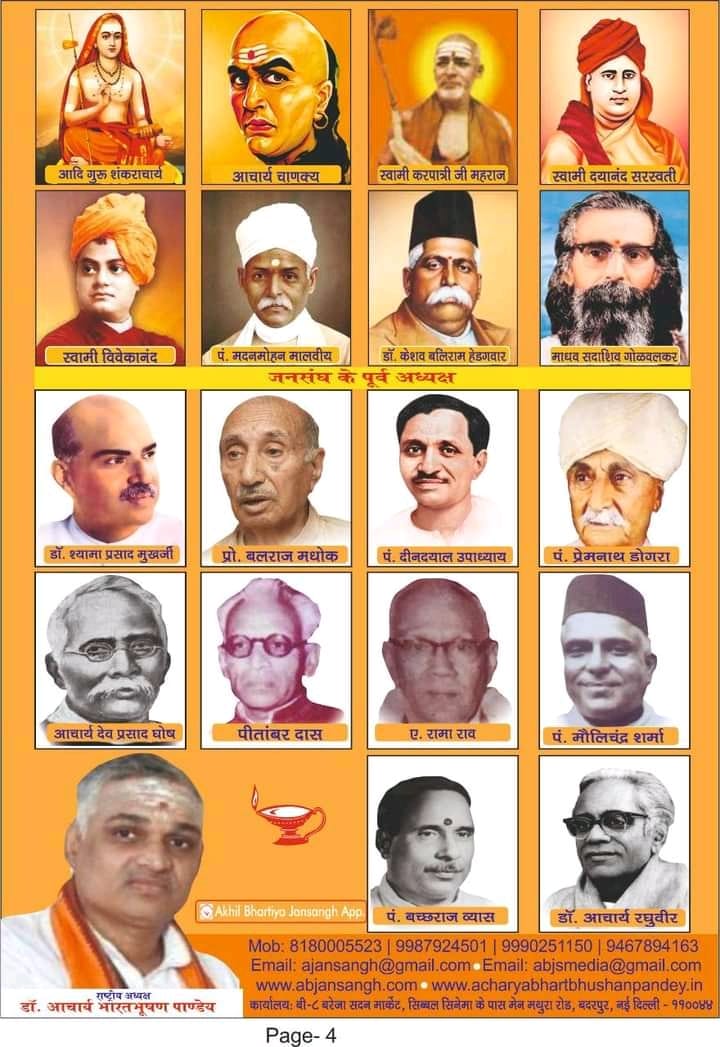
The formation of Bharatiya Jana Sangh into Akhil Bharatiya Jana Sangh, the strong commitment to principles and determined leadership of Prof. Balraj Madhok to Dr. Acharya Bharat Bhushan Pandey. Bharatiya Jana Sangh, formed on 21 October, 1951 in Arya Raghumal Vidyalaya, New Delhi under the Chairmanship of the great martyr Dr. Syama Prasad Mookerjee and with the participation of patriots like Pandit Maulichandra Sharma, Sh. Vaidya Gurudutt, Sh. Lala Yodhraj, Prof. Balraj Madhok etc., is the rst nationalist-realist party of independent India which gave a clarion call for an alternative to Nehruvism and cultural nationalism inside and outside the Parliament. The Bharatiya Jana Sangh emerged as an alternative to non-Indian rule in India, insisting on the interpretation and application of Indian political, socio-economic policies in modern contexts, and as a credible forum for the nation's unity and integrity. Dr. Syama Prasad Mookerjee saved half of Bengal and half of Punjab from ceding to Pakistan. He sacriced his life to remove many anti-national distortions, including two constitutions, two heads, and two ags, from Jammu and Kashmir. Pandit Deendayal Upadhyay, as General Secretary, and Prof. Balraj Madhok, as National Secretary and spoksman, launched an intensive campaign of organization and propaganda, transforming the Jana Sangh into a major party in India and a world-known organization, based on its distinct ideology and character. The leaders of the then Christian Democratic Party (CDP) in European countries recognized the Jana Sangh as India's Hindu Democratic Party (HDP), and its leaders, especially Prof. Balraj Madhok, were considered leaders of India and authentic representatives of the world's Hindus. Prof. Balraj Madhok became the 9th National President of the Jana Sangh. Under Prof. Madhok's leadership, in the 1967 general elections, nearly 100 MPs were got elected to the Lok Sabha through an alliance with the Swatantra Party and some independent candidates supported by Jana Sangh. The Jana Sangh alone had 35 MPs and became the rst or second party in several state assemblies. At the Calicutt convention in December 1967, the great thinker Pandit Deendayal Upadhyay, the pioneer of Integral Humanism, became the National President. However, on February 11, 1968, his body was found in the Mughalsarai yard (now Pandit Deendayal Upadhyay Junction). The suspected murder of Dr. Mookerjee in Srinagar jail, the death of Acharya Dr. Raghuveer in a road accident, and the mysterious murder of Pandit Deendayal Upadhyay dealt a severe blow to the Jana Sangh and its progress. The mystery surrounding these unfortunate murders has yet to be unraveled. In 1973, dominant gures within the Bharatiya Jana Sangh (All India Jan Sangh) had differences with Prof. Balraj Madhok, the founding Secretary and Dr. Mookerjee's close associate, condant, inuential parliamentarian and author of the party's rst manifesto, the 9th National President of the Jana Sangh, got expelled him from the party he had founded. Prof. Madhok, determined to protect and not to harm the original Jana Sangh, which he had nurtured during the golden years of his life and youth, did not form a parallel Jana Sangh. This strengthened Prof. Madhok's image as a principled and dedicated politician and got increased public respect for him, which remained with him throughout his life. During the Emergency, when all opposition leaders were imprisoned, the decision was reached within the prisons through mutual coordination among the leaders to adopt the name "Janata Party" and the Chakra Haldhar (the wheel and ploughshare) election symbol of Chaudhary Charan Singh's "Bharatiya Lok Dal." It is worth noting that in 1977, the Janata Party government was formed rst, the organization was formed later. Before this, there had been no formal merger of parties; instead, other parties suspended their programs and came together under the name of the Janata Party to free the common people from the pain of the Emergency and to get rid of the misrule of Indira Congress. In 1977, Prof. Madhok was not in government or in the Parliament even. He had never compromised on his ideology or principles. When Shri Morarji Desai's Janata Party government began to surpass the Congress in appeasement and, despite Prof. Madhok's repeated warnings, began to move away from the national interest, the Minority Commission and others were formed.

Then, on January 4, 1979, Prof. Balraj Madhok convened a conference of patriotic colleagues and workers of the Bharatiya Jana Sangh, from its inception to the present, at Ramlila Maidan, New Delhi. The Bharatiya Jana Sangh was re-organised under the name of Akhil Bharatiya Jana Sangh (All India Jan Sangh), adopting the same constitution, election symbol, ideology, ideals, and policies. Prof. Balraj Madhok was again got elected as its National President. On April 6, 1980, the Bharatiya Janata Party came into being. Its stage featured pictures of Gandhi and Jai Prakash Narain. In his speech, Mr. Lal Krishna Advani described the party as distinct from the Jana Sangh and the true Janata Party. Mr. Atal Bihari Vajpayee had said that we had drowned the Jana Sangh's lamp (Deepak) in the Yamuna. Mr. Advani had said that we should not be linked to the Jana Sangh. We had no connection with the Jana Sangh. We had become MPs and central government ministers on the Lok Dal ticket. Despite this, the Bharatiya Janata Party did not achieve electoral success. Jtheir leaders had ample resources and an organizational network of dedicated workers. Meanwhile, Prof. Balraj Madhok, along with a handful of dedicated associates, was ghting on the ground, intensifying the ideological revolution through his articles and books. The Bharatiya Janata Party took advantage of this situation. As President, Shri Lal Krishna Advani made a U-turn, calling himself the true Jan Sangh. He began displaying portraits of its founders, especially Dr. Syama Prasad Mookerjee and Pandit Deendayal Upadhyay, and adopted Integral Humanism as a principle instead of Gandhian socialism. Adopting all the Jan Sangh's issues, he created a new atmosphere in the country through the Rath Yatra. This sent the message to the public that there were two Jan Sanghs. Due to the dut to continued efforts of Prof. Balraj Madhok, the Bharatiya Janata Party was forced to become the Jan Sangh upto some extent, which reaped its full benets. The Akhil Bharatiya Jan Sangh (All India Jan Sangh) exists in its seed form. In the future, it will emerge as a genuine representative of ancient India and, in keeping with the ideals of Pandit Deendayal Upadhyay, will purify politics and bring about Swaraj (self-rule) based on the policy of giving appropriate place to the deserving. People exploited and deceived Prof. Balraj Madhok. Due to Prof. Balraj Madhok's simplicity and trustworthiness, and the severe lack of resources, the Jana Sangh was unable to achieve signicant success again. At this time, Dr. Acharya Bharat Bhushan Pandey, who had been active as Balraj Madhok's associate since 1990 and served as the Bihar Jana Sangh's state President for 12 consecutive years, has been elected National President after Prof. Balraj Madhok's death. He has been working tirelessly and strategically for restoring the Jana Sangh and its lost ground again and promoting the Indian political culture as well as socio-economic policies based National Party.